BASH Guideline
Section 1: The Clinical Approach
Section 2: Primary Headaches

2.1 Migraine
2.1.2 Clinical features
Migraine is characterised by recurrent episodes of moderate to severe headaches, unilateral or bilateral and frequently throbbing. There may be associated nausea/vomiting, and light, noise and/or motion sensitivity (Blau & Dexter, 1981; Davies et al., 1991; Lance & Anthony, 1966; Olesen, 1978; Rasmussen et al., 1991; Russell et al., 1996) (http://www.ichd- 3.org).
Attacks can last 4-72 hours with freedom from symptoms in between, and vary in frequency from one per year to a few times per month (Kelman, 2006; Russell et al., 1996; Selby & Lance, 1960; Stewart, Schecter, et al., 1994).
The median frequency is one to two attacks per month (Lipton et al., 2000).
Headache on 15 or more days per month for 3 consecutive months, of which at least 8 days have features of migraine, is termed chronic migraine (http://www.ichd-3.org).
The most sensitive and specific features of migraine are (Lipton et al., 2003):
- Nausea
- Disability (limitation of activity
- Photophobia
Prior to the onset of headache, patients can frequently experience premonitory symptoms, the most common of which are feeling tired (72%), difficulty concentrating (51%), and a stiff neck (50%) (Giffin et al., 2003).
After the headache has ended patients often experience postdrome symptoms of a similar nature. In most attacks (93%), there was return to normal within 24 hours (Giffin et al., 2016).
Aura affects around a third of migraine sufferers (Rasmussen & Olesen, 1992; Russell et al., 1995).
A typical aura comprises of fully reversible visual and/or sensory/ and/or speech symptoms, evolving over minutes with a total duration of up to 60 minutes (http://www.ichd-3.org).
Aura may occur without headache particularly in older patients (Dodick, 2003).
Aura usually precedes, but may occur during, or after the headache.
Aura is not unique to migraine. It may occur in other forms of primary headaches (Krymchantowski, 2005).
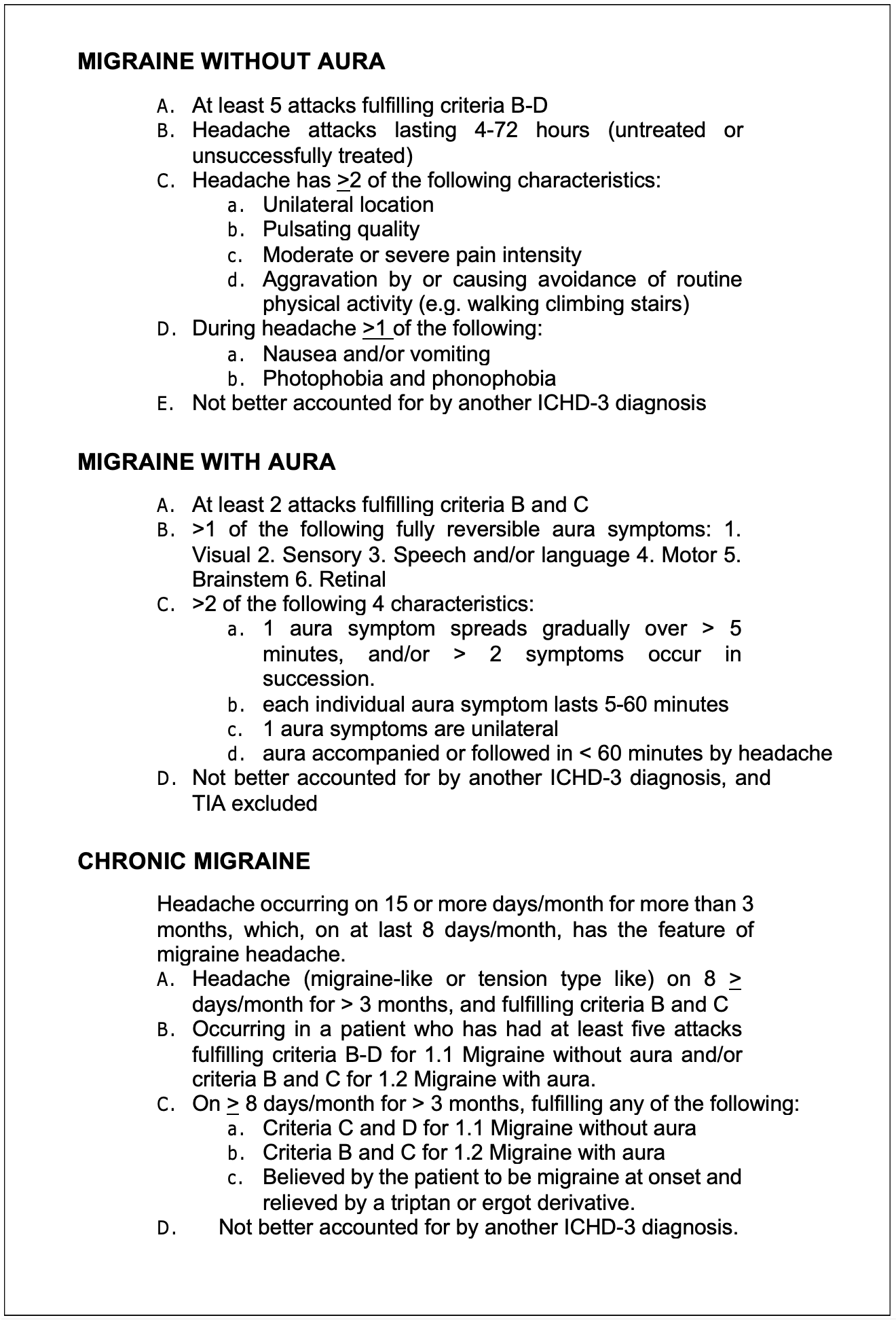
The current classification of migraine with or without aura is well validated (D'Amico et al., 1994; Davies et al., 1991; Kelman, 2006; Lance & Anthony, 1966; Momoh-Ojewuyi et al., 2013; Olesen, 1978; Rasmussen et al., 1991; Russell et al., 1996; Selby & Lance, 1960) (see table 1), though these classification systems are used primarily as a research tool rather than in everyday clinical practice.
Table 1: International headache classification definitions of migraine