BASH Guideline
Section 1: The Clinical Approach
Section 2: Primary Headaches

2.4 The trigeminal autonomic cephalalgias
2.4.2 Paroxysmal hemicrania
2.4.2.1 Epidemiology
Population-based data on the prevalence of paroxysmal hemicrania is sparse and has been cited as 0.05% in the 18-65-year age group (Sjaastad & Bakketeig, 2007)394.
Total published cases remain less than 200.
There may be a slight female preponderance with ratios ranging between 1.1to 2.36.
Mean age of onset is between the 4th and 5th decades (Boes & Dodick, 2002; Cittadini et al., 2008; Prakash et al., 2013).
2.4.2.2 Clinical features
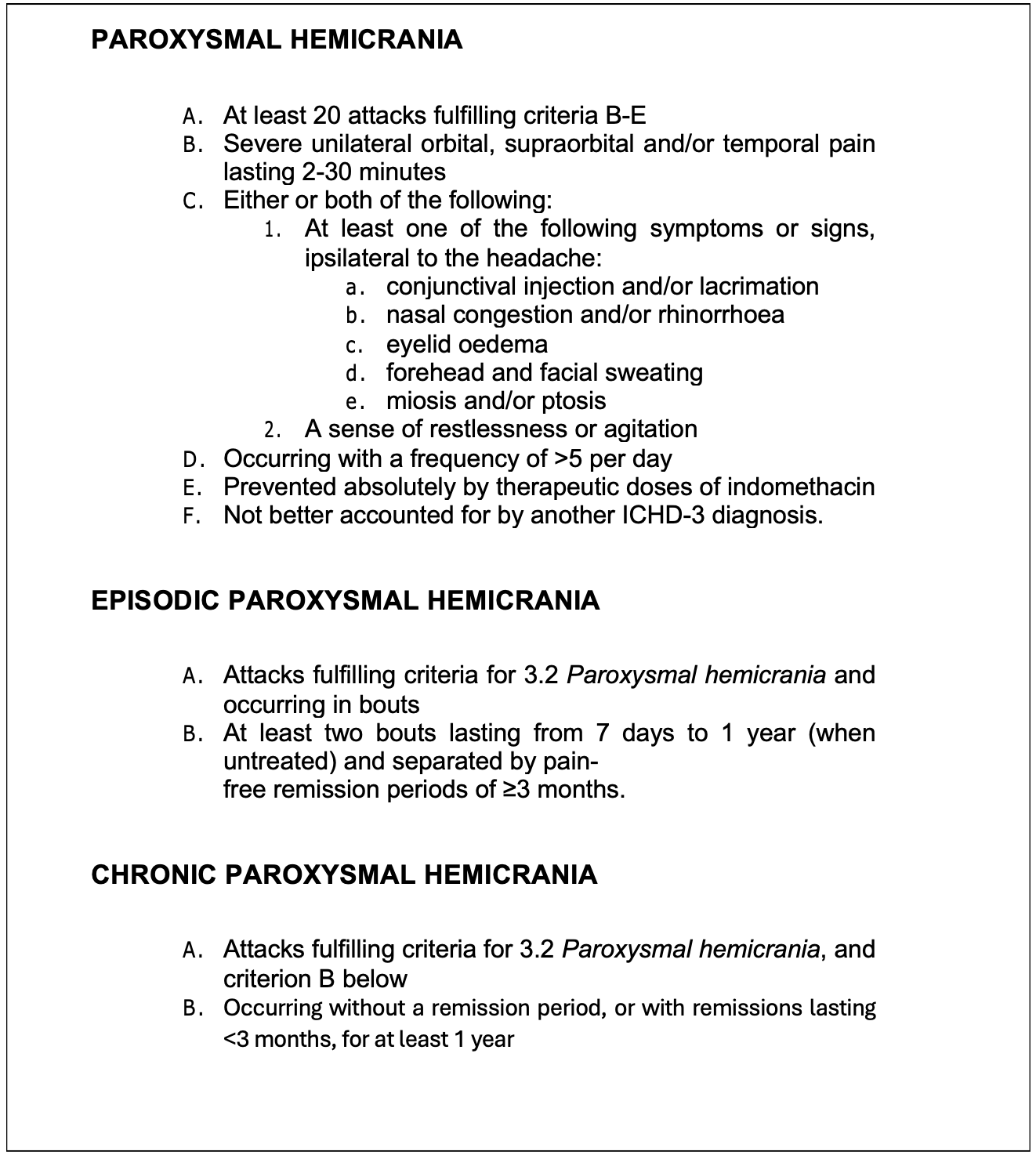
The pain is strictly unilateral with associated ipsilateral autonomic features (http://www.ichd-3.org).
The classification of paroxysmal hemicranias is shown as an appendix.
Attack duration ranges between 2-30 minutes and frequency of attacks is reported up to 50 a day. The mean lies between seven and 13 attacks per day 46,395.
A greater proportion present with chronic paroxysmal hemicrania. The disorder has an absolute response to indomethacin (Antonaci & Sjaastad, 1989; Boes & Dodick, 2002; Cittadini et al., 2008; Prakash et al., 2013; Prakash & Patell, 2014).
The attacks are shorter and more frequent than in cluster headaches and longer and less frequent than in SUNCT/SUNA. The typical circadian characteristics seen in cluster headache are less prominent in paroxysmal hemicrania. All attacks are spontaneous unlike SUNCT/SUNA, in which attacks are often triggered immediately by various sensory stimuli. The key distinction is the clear therapeutic response to Indomethacin. The main differential diagnoses are shown are shown as an appendix.
2.4.2.3 Management
There are no RCTs for preventive treatment in paroxysmal hemicranias.
A) Acute treatment
The attacks of paroxysmal hemicrania are usually too short to respond to any oral acute treatment. Open label observation suggests that sumatriptan 6mg subcutaneous injection and high flow oxygen are generally not effective (Antonaci et al., 1998; Dahlöf, 1993).
B) Preventive treatment
By definition paroxysmal hemicrania is an indomethacin-responsive disorder.
The effective dose range is between 25-300mg daily dose (Antonaci & Sjaastad, 1989; Boes & Dodick, 2002).
Although most patients show a rapid response to indomethacin, some patients can take up to a week to demonstrate a response to an effective dose. Based upon this BASH recommends indomethacin 25mg PO TDS for 7 days, 50mg TDS 7 days, up to 75mg TDS. We recognise and emphasise the higher dose is above the BNF quoted maximum of 200mg per day, and should only be considered if clinically required, after appropriate counselling with the patient, and with clear criteria for dose reduction.
Dose requirements can change over time and some patients may go into remission (Pareja et al., 2001).
Therefore, once symptoms are well controlled for a period of time gradual dose reduction should be tried to maintain the lowest effective dose or, if there is no recurrence on each dose reduction, withdrawal during remission periods.
Gastrointestinal side effects with indomethacin are common and may preclude use of the drug. A concomitant proton-pump blocker or H2-antagonist can be used.
Appendix 1: Classification of paroxysmal hemicranias (http://www.ichd-3.org)