BASH Guideline
Section 1: The Clinical Approach
Section 2: Primary Headaches
2.4 The trigeminal autonomic cephalalgias
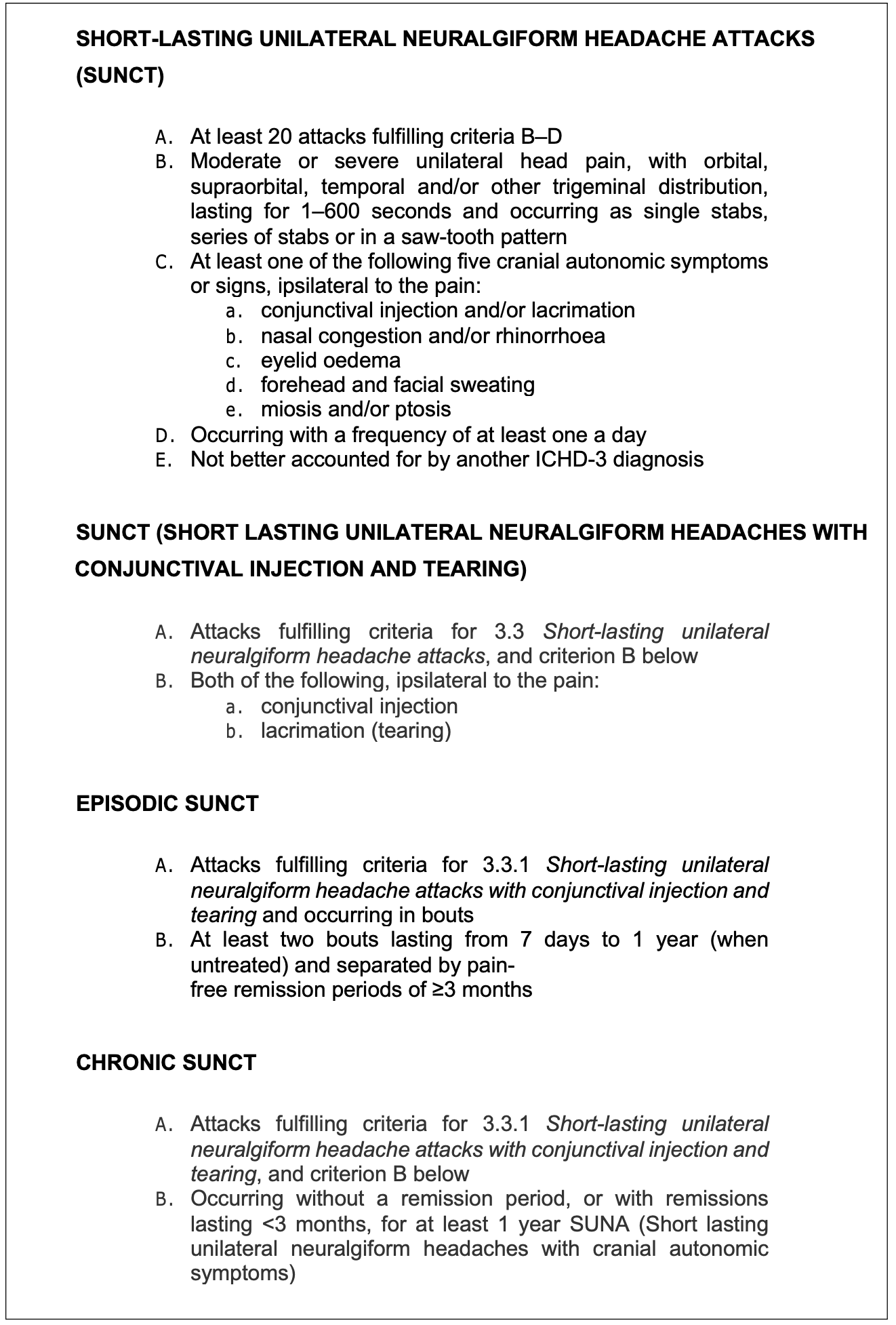
2.4.3 SUNCT/SUNA
The original description of this disorder was termed SUNCT, short-lasting unilateral neuralgiform attacks with conjunctival injection and tearing (Sjaastad et al., 1989).
Conjunctival injection and tearing (lacrimation) are the most common autonomic symptoms in all the TACs (Cittadini et al., 2008; Prakash et al., 2013; Bahra et al., 2002; Cittadini & Goadsby, 2010; Kudrow, 1980; Schurks et al., 2006; Torelli et al., 2001).
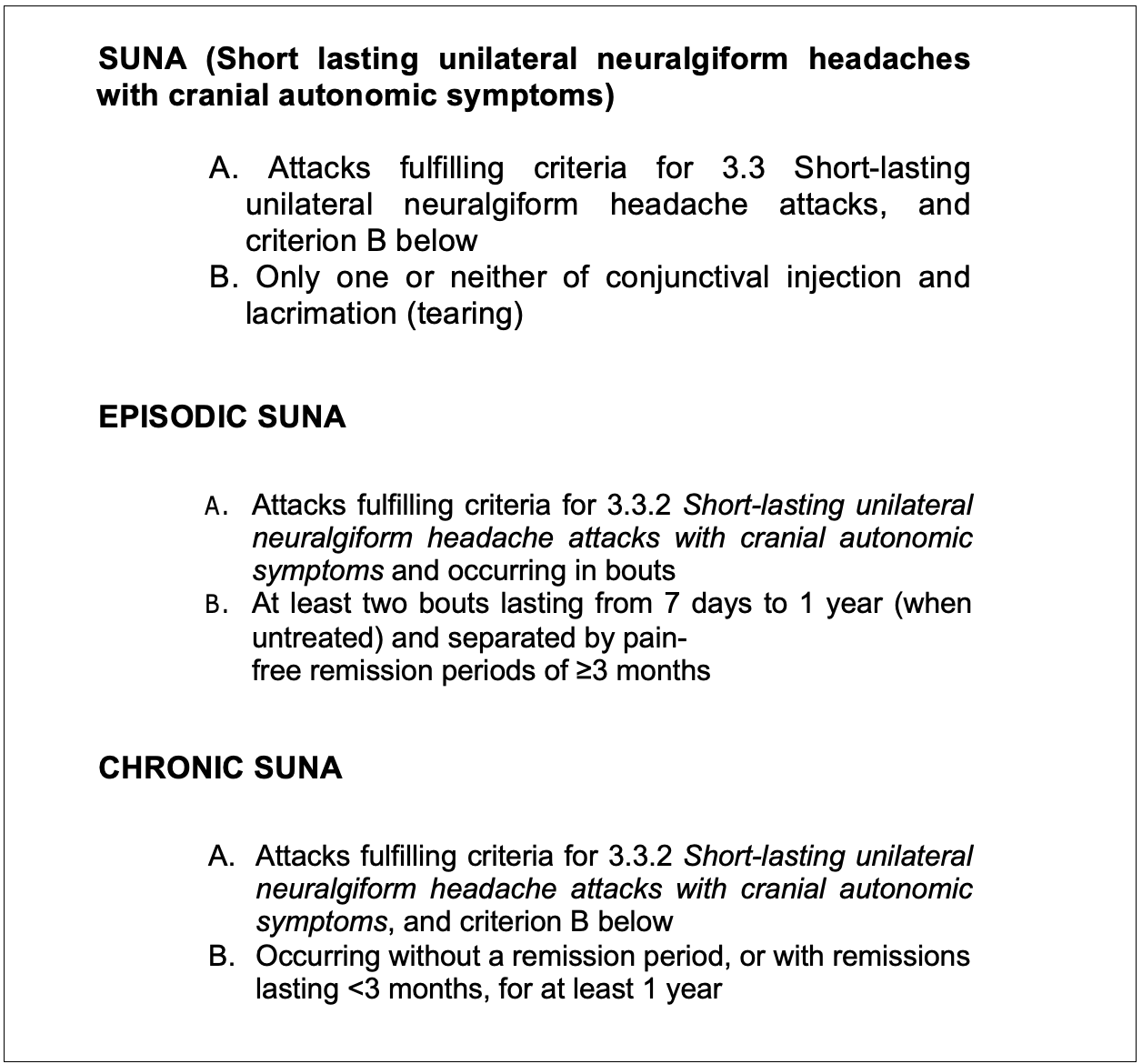
The terminology SUNA was proposed based on the fact that a number of patients were noted to lack one or both of these symptoms (Williams & Broadley, 2008) (Weng et al., 2017). The distinction remains within the ICHD classification. From a clinical perspective, management remains the same.
The distinction remains within the ICHD classification. BASH recommends this as a research tool and for current clinical purposes will adopt the terminology of SUNA to encompass both groups (Weng et al., 2017).
2.4.3.1 Epidemiology
SUNCT/SUNA is rare (Sjaastad & Bakketeig, 2003; Williams & Broadley, 2008)
The mean age of onset is 48 years with a slight male preponderance 1.5 (Favoni et al., 2013).
2.4.3.2 Clinical features
The attacks are the shortest and most frequent of all the TACs. Attacks can be either spontaneous or induced by cutaneous triggers. Mean duration is about one minute (range 1-600 seconds) with frequency up to 30 attacks in an hour (Cohen et al., 2006).
The character of the attacks can vary: attacks can occur in single stabs, a group of stabs or a long attack with a ‘saw-tooth’ pattern of stabs between which the pain does not return to baseline. Other features of TACs may be present, such as agitation. SUNCT/SUNA can be misdiagnosed as Trigeminal Neuralgia. However, the location of the pain, autonomic features, duration of attacks and spontaneity of attacks in SUNCT/SUNA, differentiate between the two (see Section 2.4.3.2 Appendix 2: Differential diagnosis of the trigeminal autonomic cephalalgias and trigeminal neuralgia).
2.4.3.3 Management
There are no RCTs for preventive treatment in SUNCT/SUNA.
A) Acute treatment
Because of the short attack duration there are no effective acute treatments in SUNCT/SUNA (Weng et al., 2017).
B) Preventive treatment
The most effective reported treatment is lamotrigine with dose range up to 400 mg. Topiramate may be effective in SUNCT (Cohen et al., 2007). Carbamazepine and gabapentin may also be effective (Cohen et al., 2006; Pareja et al., 1995; Weng et al., 2017)